Talks that shaped this one
The people whose work built the stack at the heart of the talk — plus a rolling list of recent clustering developments worth following.
What's new in clustering
A rolling list of recent developments — papers, algorithms, libraries. Newest first.
ACM DL · DOI 10.1145/3772363.3798816
Flagged for the rolling list. Page is behind the ACM paywall; title and one-line summary to be filled in once Seth has access.
Inspirational talks
UMAP: Uniform Manifold Approximation and Projection
The canonical UMAP talk by its creator. Explains why the knobs behave the way they do — the foundation under the n_neighbors and min_dist sweeps in The Good. Same lab also brought us HDBSCAN and EVoC.
High Quality, High Performance Clustering with HDBSCAN
The original SciPy introduction to HDBSCAN, by its other co-author. Why density-based wins on irregular real-world data, and what makes the hierarchical extension a step-change over DBSCAN. Pair with Healy's 2018 walkthrough below for the full intuition.
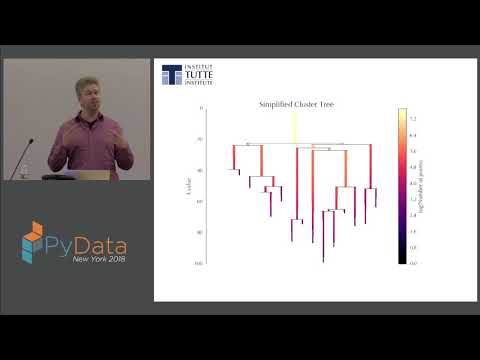
HDBSCAN, Fast Density Based Clustering — the How and the Why
The canonical HDBSCAN walkthrough by its co-author. Why density-based, why hierarchical, and why the noise label matters — the intuitions sitting under The Good's clustering stage.
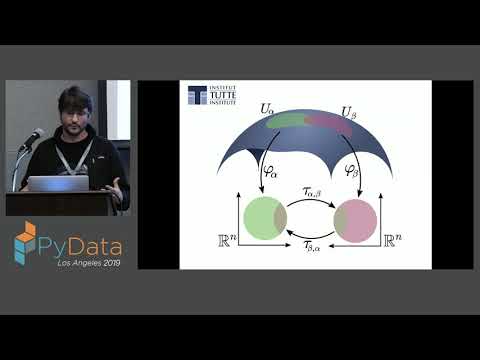
Topological Techniques for Unsupervised Learning
The math under the whole Tutte stack — the same topological lens that produces UMAP also produces HDBSCAN and later EVoC. Watch this once and the family resemblance between the libraries stops being a coincidence.
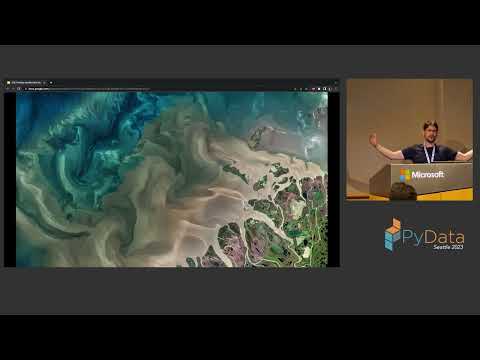
Data Mapping for Data Exploration
The pitch for treating the 2-D map itself as the EDA artifact — not the pipeline output. The framing behind the interactive datamapplot views in The Beautiful, and the reason the 100K map is the centerpiece, not a postscript.
BERTopic: Topic Modeling with Transformers
BERTopic's author walking through the design: embeddings → UMAP → HDBSCAN → c-TF-IDF. The "modern pipeline" argument in The Good traces back to this framing.
Guides & references
Foundational learning resources — the docs and courses to start with if clustering is new, or to bookmark if you're going deeper.
Clustering · scikit-learn user guide
The canonical Python reference. Walks every clustering algorithm scikit-learn ships — k-means, DBSCAN, OPTICS, hierarchical, spectral, mean-shift, affinity propagation, Birch, HDBSCAN — with the famous comparison-plot grid showing where each one wins and fails. The single best one-page survey of clustering in Python.
Clustering Algorithms · Google ML Crash Course
Google's introductory unit on clustering. Lays out the four families — centroid-based, density-based, distribution-based, hierarchical — with concrete examples and the trade-offs between them. The clearest conceptual ladder for anyone new to the topic.
A Comprehensive Survey of Clustering Algorithms
The academic deep dive. Covers the field end-to-end — definitions, distance and similarity measures, evaluation indicators, traditional algorithms (partition, hierarchical, density-based, grid-based, model-based) and modern ones (high-dimensional, large-scale, stream). The reference to reach for when "which algorithm should I use?" needs a rigorous answer; pair with the sklearn guide for the Python equivalents.
Articles & benchmarks
clustering_arena
Head-to-head comparison of clustering algorithms on selected real-world datasets, with ground-truth labels. The kind of benchmark that makes the case in The Bad concrete — k-means doesn't just lose by a hair, it lands on the wrong structure.
You Are Probably Using the Wrong Clustering Algorithm
The companion essay to clustering_arena. The argument: k-means is fast and explainable, but on most real datasets it confidently assigns points to clusters that contradict the actual structure — and with no noise label, you don't see the failure.
Podcast · Learning from Machine Learning
Learning from Machine Learning
My podcast on the insights behind a career in machine learning and data science — industry practitioners on what they've learned, what the field is becoming, and how it's reshaping the world around us.